
Drawer Dividers vs. Rolling Carts vs. Door Organizers: Match the Organizer to the Mess, Not the Room
Why the “kitchen organizer” you bought is failing in the kitchen — and the 30-second test that fixes it
You know that rolling cart you bought during a sale because the listing photo showed a dreamy, colour-coded kitchen? Be honest about where it is right now. If it’s parked in a corner holding one dupatta, two chargers, and a packet of Maggi, you’re not alone — and the cart isn’t the problem.
The problem is how most of us shop for organizers. We search by room — “kitchen organizer,” “bathroom storage” — when we should be diagnosing the mess first. The debate of drawer dividers vs. rolling carts vs. door organizers isn’t really about which product is best. Each one solves a completely different type of clutter, and once you can name your mess type, the right organizer picks itself.
Quick answer: Drawer dividers fix “scatter mess” — small items mixing together in one space. Rolling carts fix “migration mess” — things you use in multiple spots with no fixed home. Door organizers fix “overflow mess” — flat, frequently grabbed items that have run out of shelf space. Diagnose the mess type first; the room doesn’t matter.
01 / Drawer Dividers vs. Rolling Carts vs. Door Organizers: What Each One Actually Fixes
Walk through any Indian home — a 1BHK in Hyderabad or a sprawling house in Vijayawada — and you’ll find the same three messes wearing different costumes. Once you see them, you can’t unsee them.
Scatter mess: small things mixing in a shared space
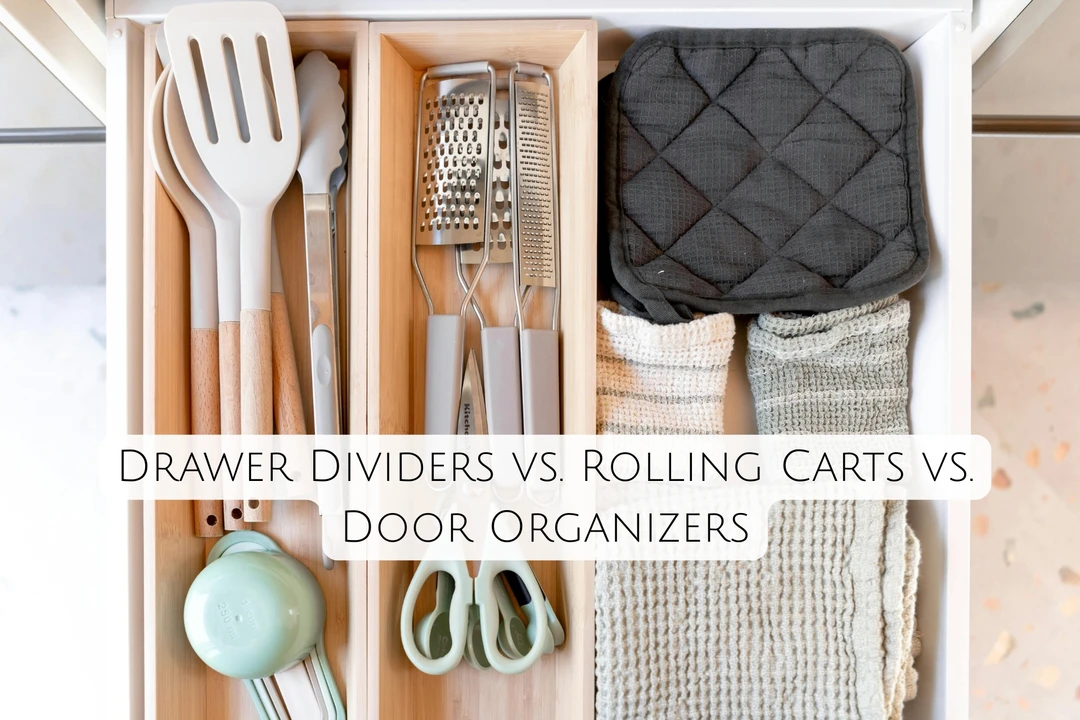
Open your cutlery drawer. If spoons, bottle openers, rubber bands, and that one mystery key have merged into a single civilisation, that’s scatter mess. It happens anywhere small items share one container: the bindi-and-safety-pin drawer, the medicine box, the “everything” drawer near the fridge.
Scatter mess needs internal boundaries, not more space. Give the drawer more room and the chaos simply expands to fill it. Drawer dividers work because they force every category into its own lane — spoons can’t drift into the whisk section, and hair ties can’t colonise the nail cutter’s spot.
Migration mess: things that live in three places at once
Some items don’t belong to a room at all. Your chai station gets used in the kitchen, sipped on the balcony, cleared in the hall. A toddler’s craft supplies follow the toddler. The iron and its spray bottle wander between bedroom and hall. When an item’s “home” changes with the time of day, shelves fail — because a shelf assumes the item stays put.
That’s the job of a rolling cart. It gives migrating items one consistent home that travels with the routine. The cart isn’t extra storage; it’s a moving address.
Overflow mess: flat, frequent-use items with no home left
Then there’s the stuff piled on counters and stuffed behind other stuff — not because you own too much, but because every horizontal surface is taken. Chip packets and masala pouches slumped in a heap. Slippers breeding at the entrance. Cleaning sprays crowding under the sink.
Overflow mess needs vertical real estate, and the most ignored vertical surface in any Indian home is the back of a door. A door organizer turns dead space into a grid of pockets — perfect for flat or light items you grab often but display never.
02 / Same Organizer, Different Rooms: Matching Mess Type in Real Indian Homes
Here’s where the “mess, not room” idea earns its keep. The same product solves wildly different problems depending on which mess it’s pointed at.
Where drawer dividers quietly win
- The masala drawer — If you’ve moved past the classic steel masala dabba to pouches and refill packs, dividers keep jeera from burying the kasuri methi. Stand pouches upright between dividers and you can read every label at a glance.
- The dressing table drawer — Bindis, earrings, kajal, safety pins, and hair pins are the ultimate scatter species. One divided drawer replaces four tangled pouches — and ends the 8:55 a.m. earring hunt before office.
- The medicine drawer — Separating fever meds, cuts-and-burns supplies, and daily supplements into divided sections matters most at 2 a.m., when you’re searching by phone torch with a crying child on your hip.
- The wardrobe’s inner shelf — Dividers turn one deep shelf into slots for innerwear, socks, and handkerchiefs — the difference between folded stacks and an archaeological dig.
Where a rolling cart earns its wheels:
If you’ve ever typed “how to organize a small Indian kitchen without renovating” at midnight, the answer is usually a cart, not a carpenter. Three high-impact uses:
- The overflow pantry — Atta, rice, dal, and oil bottles rarely fit in built-in cabinets. A sturdy three-tier cart beside the platform becomes a mobile pantry you can wheel aside for cleaning — crucial in homes where the floor gets a daily pocha.
- The chai/coffee station — Kettle or saucepan supplies, tea, sugar, biscuits on one cart. It rolls to the balcony on Sunday mornings and back against the wall by Monday.
- The festival and pooja cart — Diyas, agarbatti, kumkum, cotton wicks, and match boxes scatter across the year and vanish exactly when Diwali arrives. Parking them on one cart means festival prep starts with a push, not a search party.
One honest caveat: a rolling cart is the easiest organizer to abuse. If nothing on it actually migrates, it degenerates into a horizontal junk drawer with wheels. The wheels should serve a routine, not an aesthetic.
Where door organizers do their best work
- Behind the kitchen door — Clip-style pockets hold chips, papad packets, and open masala pouches upright and visible. In humid coastal weather, getting half-open packets sealed and off the counter also keeps ants uninterested.
- Behind the bathroom door — Extra soaps, sachets, shampoo pouches, and shower caps sit in pockets instead of sweating on the window ledge. If you’ve searched for “over the door organizer ideas for small apartments,” the bathroom is where you’ll feel the win first — it’s usually the smallest room with the most SKUs.
- Behind the bedroom door — Belts, dupattas, caps, and daily-wear jewellery pouches — flat, light, grabbed daily. Exactly the profile a door grid loves.
- At the entrance — A slim shoe organizer behind the main door swallows the chappal pile that greets your guests. Reserve floor racks for bulky shoes; pockets handle flats and slippers.
Two practical checks before you buy: confirm your door clears the frame with hooks on (many Indian flush doors have barely 6–8 mm of gap), and keep heavy bottles off door organizers — hollow-core doors sag and hinges complain.
A word on materials, because Indian weather has opinions:
Whatever you pick, the climate gets a vote. In coastal and monsoon-heavy cities, plain mild-steel carts start showing rust freckles within a season — look for powder-coated metal or thick virgin plastic instead. Bamboo and MDF drawer dividers, lovely in dry Delhi winters, can swell and jam in 80% humidity; adjustable plastic or coated-metal dividers survive the wet months better.
For door organizers, fabric pockets breathe better than PVC in humid bathrooms, where sealed plastic pockets trap moisture and smell musty by August. And skip cardboard “organizer boxes” anywhere near a Mumbai or Vizag monsoon — they’re compost with extra steps.
03 / Why Most Organizers Fail Within a Month (And How to Choose in 30 Seconds):
Organizers don’t fail because they’re badly made. They fail because they were prescribed for the wrong disease. The three classic mistakes:
- Buying the organizer before diagnosing the mess — This is the sale-season trap. The product arrives, the mess it suits doesn’t exist in your home, and the organizer itself becomes clutter. Diagnosis first, cart later — literally.
- Using a cart for scatter mess — Tossing loose small items onto open cart tiers just elevates the chaos to eye level. Small mixed items need dividers; carts need grouped, tray-sized loads.
- Using dividers for migration mess — Beautifully dividing a drawer for items that get used across three rooms guarantees the drawer stays empty and the items stay everywhere else. Storage must match movement.
The 30-second mess test:
Stand in front of any cluttered spot and ask three questions in order. First: are these small items mixing together in one space? Buy drawer dividers. Second: do these items move between rooms as part of a routine? Buy a rolling cart. Third: are these flat or light items with no surface left to live on? Buy a door organizer. If you answered no to all three, you don’t have an organizing problem — you have a decluttering problem, and no product fixes that.
Advanced move: stack the systems
The three organizer types aren’t rivals; the best setups chain them. Drop a small divided tray onto a rolling cart tier and your chai station gets internal boundaries — sugar sachets stop swimming among tea packets. Let a door organizer act as the “intake” for a cart: new sachets and refill pouches land in door pockets, and once a week you transfer what’s opened onto the cart. Migration mess and overflow mess often live side by side, and one product rarely clears both.
The rule of thumb: dividers create order inside a space, carts create order across spaces, and door organizers create space out of nothing. Stack them in that order of priority and you’ll rarely buy a dud.
That test also answers the eternal question of “how to stop a drawer from becoming a junk drawer”: a junk drawer is simply scatter mess plus no-home overflow sharing one address. Divide the drawer for what genuinely belongs there, and give the rest a door pocket or a cart tier — or the dustbin.
04 / Gadgets, Toys, and Travel Gear: The Messes Nobody Warns You About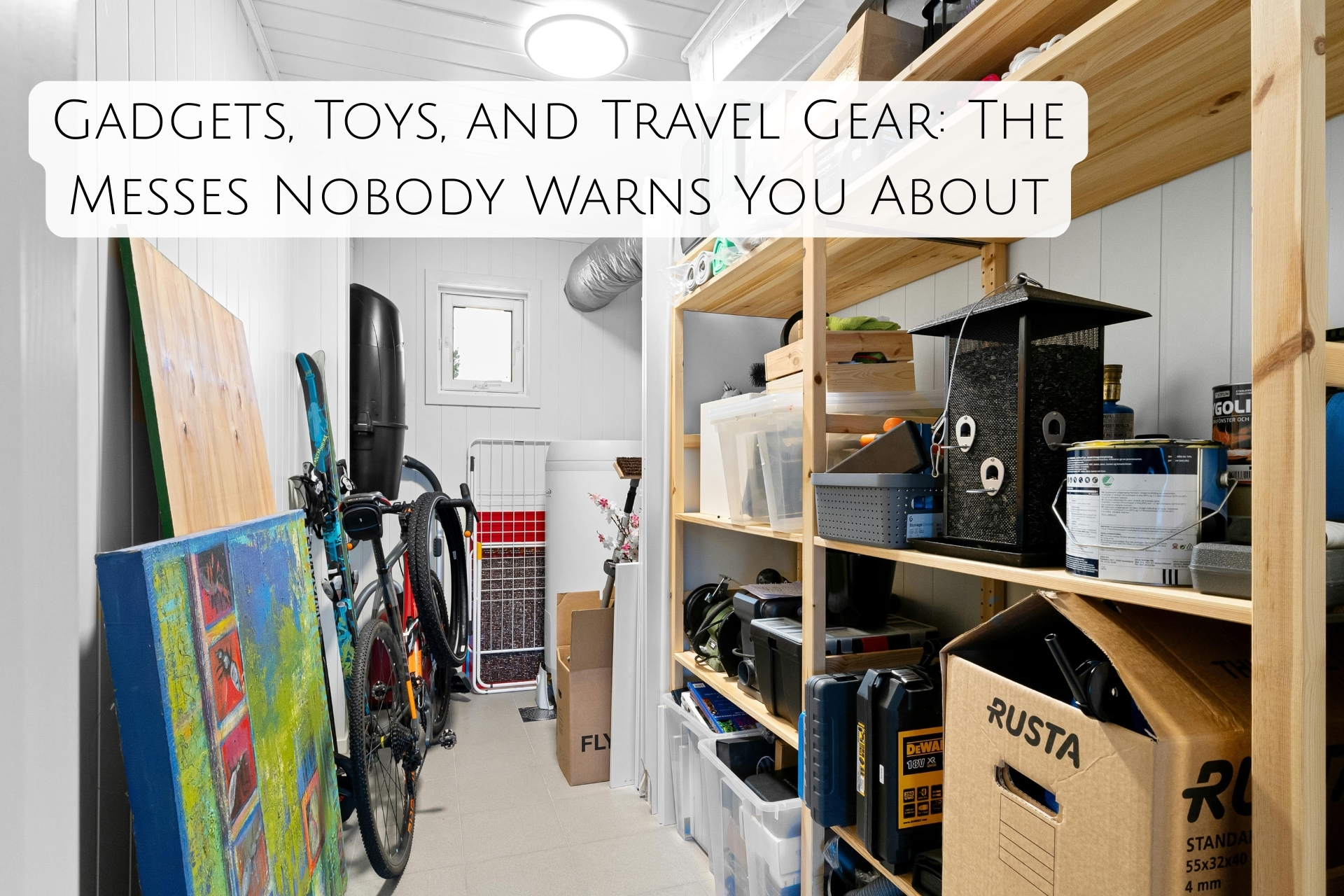
Since you’re reading this on Chimiya, let’s apply the framework to the clutter that modern Indian homes actually generate — the stuff that didn’t exist in your parents’ house. Cables, gadgets, toys, and travel gear follow the same three mess types, just with more plastic.
- Divide the charging drawer — If you’ve searched “how to organize charging cables and chargers at home,” you already know the diagnosis: pure scatter mess. Power banks, earbuds, three generations of USB cables, and the TV remote’s spare batteries all mixing in one drawer. Divided lanes — one per cable type — end the daily untangling ritual, and you’ll finally discover you own four identical Type-C cables.
- Roll the toy (or pet) cart — Toys are the definition of migration mess: they follow the child from hall to bedroom to balcony. A three-tier cart becomes a mobile toy library — evening cleanup is one lap of the house, and the cart parks in a corner overnight. Same logic for pet supplies: food, treats, leash, and grooming brush travel between kitchen, balcony, and door, so give them wheels instead of four scattered homes.
- Pocket the travel gear — Passport pouches, packing cubes, luggage tags, chargers, and neck pillows are flat, light, and used six times a year — classic overflow mess. Clear pockets behind the wardrobe door turn pre-trip packing into a grab-and-go wall instead of a suitcase excavation the night before a 6 a.m. flight.
Chimiya’s home and kitchen range is built around exactly these three jobs — adjustable dividers, sturdy multi-tier carts, and hanging organizers — because Indian homes rarely need more furniture; they need better boundaries inside the furniture they already own. Match the product to the mess, and the mess stays solved.
05 / The Takeaway: Name the Mess, Then Spend the Money
Rooms don’t create clutter — behaviours do. Scatter, migration, and overflow are the three behaviours, and drawer dividers, rolling carts, and door organizers are their three antidotes. Match them correctly and even a compact 1BHK feels like it grew a room. Match them by vibe, and you’ll own three more things to organize.
So before the next sale tempts you: stand in front of your messiest spot, run the 30-second test, and buy the organizer your mess is actually asking for. Your future 8:55 a.m. self — earrings found, keys in hand, chai station rolling
Knowledge Hub
Drawer Dividers vs. Rolling Carts vs. Door Organizers: Match the Organizer to the Mess, Not the Room
Why the “kitchen organizer” you bought is failing in the kitchen — and the 30-second test that fixes...

Do Vegetable Choppers Really Save Time, or Just Move It to Cleanup? An Honest Minutes-Per-Meal Breakdown
It's 7:40 pm. The pressure cooker is hissing, someone's asking what's for dinner, and you're standin...

Do Garden Grow Bags Actually Work Better Than Pots?
You're scrolling through a gardening page, and there it is again — another post insisting grow bags...
Cast Iron, Stainless Steel & Non-Stick
Every Indian kitchen ends up with some combination of all three — a heavy iron kadhai from your gran...
Cast Iron vs Stainless Steel vs Non-Stick: When to Use Each
Every Indian kitchen ends up with some combination of all three — a heavy iron kadhai from your gran...

700W vs 1000W Mixer Grinder: What the Wattage Actually Buys You — and When It Doesn't
Stand in any appliance aisle in India and you'll see the same little ritual. Someone picks up a mixe...